Table of Contents
Introduction
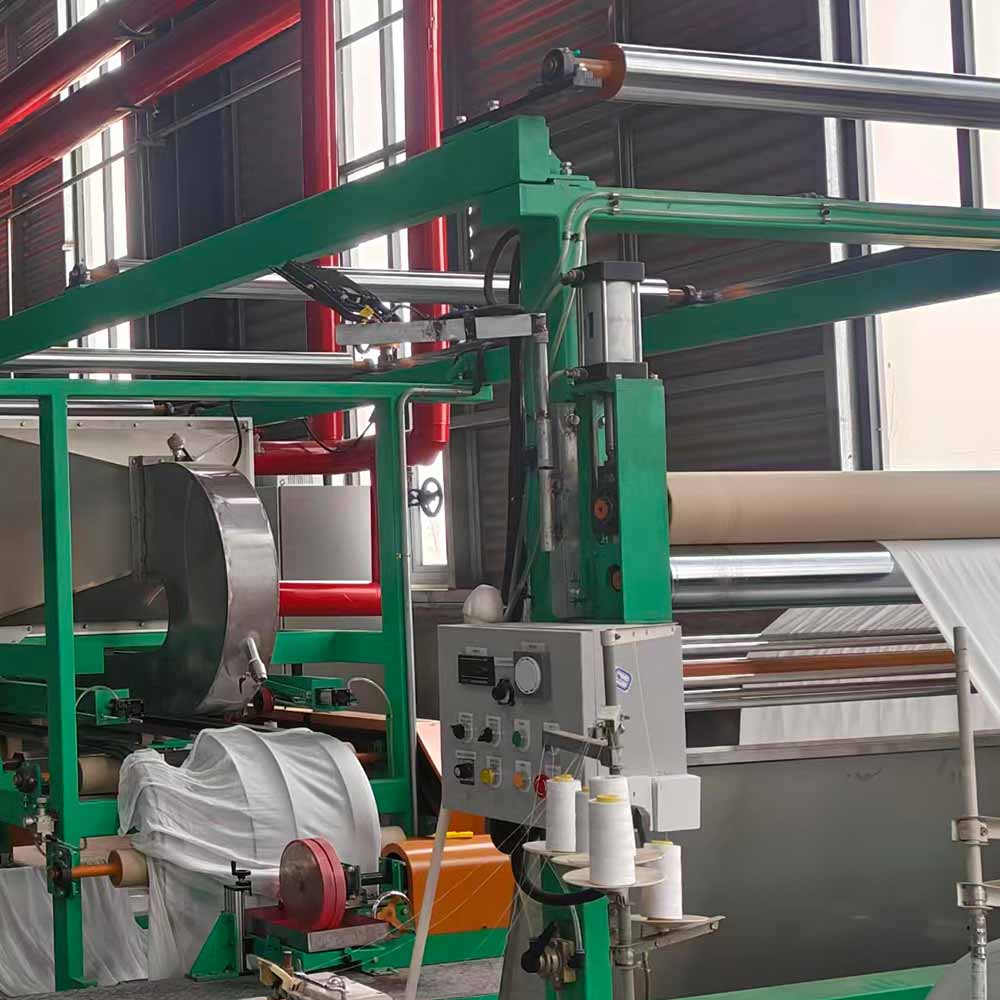
A laminating machine plays a critical role in synthetic leather manufacturing because it determines how reliably different material layers become one stable composite structure. In PU and PVC leather production, the process may involve bonding a surface layer with textile backing, foam, nonwoven fabric, film, or another functional layer.
At first glance, lamination looks simple: two materials enter the machine and one laminated material comes out. Industrial production is much more demanding. The machine must control tension, alignment, adhesive distribution, pressure, temperature, speed, cooling, and rewinding at the same time.
A small variation at one stage can cause defects that become visible much later. Poor tension control may create curling after the roll is released. Uneven pressure can produce weak bonding at the edges. Insufficient drying may look acceptable at the laminating nip but cause separation during later embossing, cutting, or sewing.
The most important points when evaluating a laminating machine are:
- compatibility with your actual substrate structure;
- stable unwinding and web tension;
- uniform adhesive or bonding-layer application;
- accurate temperature control when heating is required;
- even pressure across the working width;
- reliable web alignment;
- controllable production speed;
- effective drying, cooling, or curing;
- stable rewinding;
- repeatable settings after product changeovers.
A good laminating process therefore does more than hold two layers together. It creates a predictable material structure that can continue through subsequent manufacturing without introducing avoidable variation.
What Does a Laminating Machine Do?
A laminating machine joins two or more flexible layers to create a composite material with characteristics that one layer alone may not provide.
Synthetic leather itself is commonly constructed from polymer surface layers and textile or other supporting structures. The general concept of artificial leather includes materials designed to reproduce leather-like appearance or performance through manufactured layered structures.
Depending on the finished product, a lamination process may combine:
- PU surface material with textile backing;
- PVC material with woven fabric;
- synthetic leather with foam;
- coated material with nonwoven fabric;
- film with textile;
- decorative surface material with reinforcement;
- multiple flexible functional layers.
The objective is not simply to produce adhesion. Industrial lamination must maintain bond consistency, dimensional stability, flatness, flexibility, and usable surface quality across the complete roll.
Lamination as a Structural Process
Printing and embossing primarily change the surface appearance or texture of a material. Lamination changes its structure.
A backing layer may contribute:
- dimensional stability;
- reinforcement;
- softness;
- thickness;
- flexibility;
- handling characteristics.
This means the lamination stage can influence how the finished synthetic leather behaves during embossing, cutting, folding, sewing, or other processing.
How Does a Laminating Machine Work?
Although machine configurations vary, continuous flexible-material lamination usually follows a recognizable process sequence:
unwinding → guiding → surface or adhesive preparation → drying or activation → alignment → nip lamination → cooling or curing → inspection → rewinding.
Each section has a different responsibility.
Material Unwinding
Separate rolls enter the system through their own unwinding stations.
The machine needs to feed each layer smoothly without unnecessary stretching or sudden tension changes.
If one substrate accelerates differently from another, their relative dimensions can change before they reach the laminating point.
Web Guiding
The materials must remain correctly aligned.
Without adequate guiding, the two layers may gradually shift sideways, producing:
- exposed backing;
- uneven edges;
- reduced usable width;
- extra trimming;
- downstream tracking problems.
Edge alignment is particularly important during long continuous production runs.
Adhesive or Bonding Preparation
Depending on the process, an adhesive or heat-responsive bonding layer may be introduced.
Uniform application matters because local variations can become local variations in bond performance.
Adding more nip pressure cannot fully compensate for a bonding layer that is fundamentally uneven.
Lamination Nip
The layers meet between controlled rollers.
At this point, pressure brings them into intimate contact. Temperature may also play a role depending on the selected bonding process.
The critical requirement is uniformity across the entire working width.
Cooling, Curing, and Rewinding
The laminated structure may not reach its final stable condition immediately after leaving the nip.
Depending on the bonding system, the material may require cooling, curing, drying, or stabilization before final winding.
Rewinding tension must then be controlled carefully so the newly laminated structure is not unnecessarily stretched or distorted.
Start Laminating Machine Selection With the Materials
One of the most common equipment-selection mistakes is beginning with maximum machine specifications instead of the actual materials.
A laminating machine should be selected around the most demanding substrate combinations that will regularly enter production.
Identify the First Layer
Record its:
- material type;
- thickness;
- width;
- flexibility;
- elasticity;
- surface condition;
- temperature sensitivity.
Identify the Second Layer
Do the same for the backing or secondary substrate.
This is important because two materials can react very differently to the same tension.
For example, a relatively dimensionally stable surface material paired with an elastic knitted backing creates a different web-handling challenge from two similarly stable layers.
Consider the Complete Composite
Do not evaluate each substrate independently.
Ask what happens after they are joined.
The final composite should be checked for:
- curling;
- shrinkage;
- thickness;
- flexibility;
- surface appearance;
- bond uniformity;
- downstream processability.
The right machine configuration is determined by the behavior of the entire laminated structure.
The Six Variables That Define Lamination Quality
A reliable laminating machine controls several variables simultaneously.
1. Web Tension
Web tension determines how materials travel through the system.
The goal is not maximum tension. The goal is stable tension without unnecessary stretching.
If an elastic backing is stretched during bonding, it may contract after leaving the machine. When attached to a less elastic surface layer, that recovery creates internal stress.
Possible results include:
- curling;
- waviness;
- dimensional distortion;
- uneven edges.
Independent control becomes especially useful when substrates have substantially different mechanical behavior.
2. Roller Pressure
Pressure provides contact between the layers.
Insufficient pressure can contribute to incomplete bonding. Excessive pressure can create its own problems, especially when soft foam or compressible structures are involved.
Potential effects of excessive pressure include:
- thickness reduction;
- surface marking;
- foam compression;
- altered hand feel;
- edge deformation.
Uniform pressure is therefore more important than simply having the highest available pressure.
3. Temperature
Some laminating processes require controlled heat for activation, drying, bonding, or material conditioning.
Too little thermal input can lead to incomplete activation or drying.
Too much can influence:
- dimensional stability;
- gloss;
- softness;
- surface condition;
- backing behavior.
Temperature should always be evaluated together with line speed because speed changes exposure time.
4. Line Speed
Machine speed affects more than production output.
It changes:
- drying time;
- heating exposure;
- adhesive behavior;
- contact time;
- cooling time.
A line that produces acceptable bonding at one speed may require different settings when speed changes substantially.
The relevant production speed is therefore the speed at which quality remains stable, not merely the mechanical maximum.
5. Adhesive Distribution
Where an adhesive-based process is used, application uniformity is fundamental.
The manufacturer should pay attention to whether the bonding layer remains consistent:
- across the width;
- throughout the production run;
- during speed changes;
- after formulation adjustments.
A local adhesive shortage can become a localized separation problem later.
6. Web Alignment
Even good bonding becomes commercially less useful if the substrates do not remain aligned.
Guiding accuracy should be evaluated during continuous operation rather than only during startup.
Laminating Machine Process Variables Compared
| Process Variable | Primary Function | If Unstable | What to Inspect |
|---|---|---|---|
| Web tension | Controls material movement | Curling, wrinkles, stretching | Unwinding and tension system |
| Nip pressure | Creates layer contact | Weak or uneven bonding | Roller alignment and pressure |
| Temperature | Supports drying or activation | Poor bonding or deformation | Heating system |
| Line speed | Controls process time | Incomplete drying or instability | Whole process balance |
| Adhesive distribution | Creates bonding layer | Local delamination | Coating system |
| Web guiding | Aligns substrates | Edge mismatch | Guiding system |
| Cooling/curing | Stabilizes laminate | Post-process movement | Cooling section |
| Rewinding tension | Builds finished roll | Stretching or loose rolls | Winding system |
The useful lesson from this table is that many visible lamination defects originate before the material reaches the main pressure rollers.
Why Tension Control Matters So Much
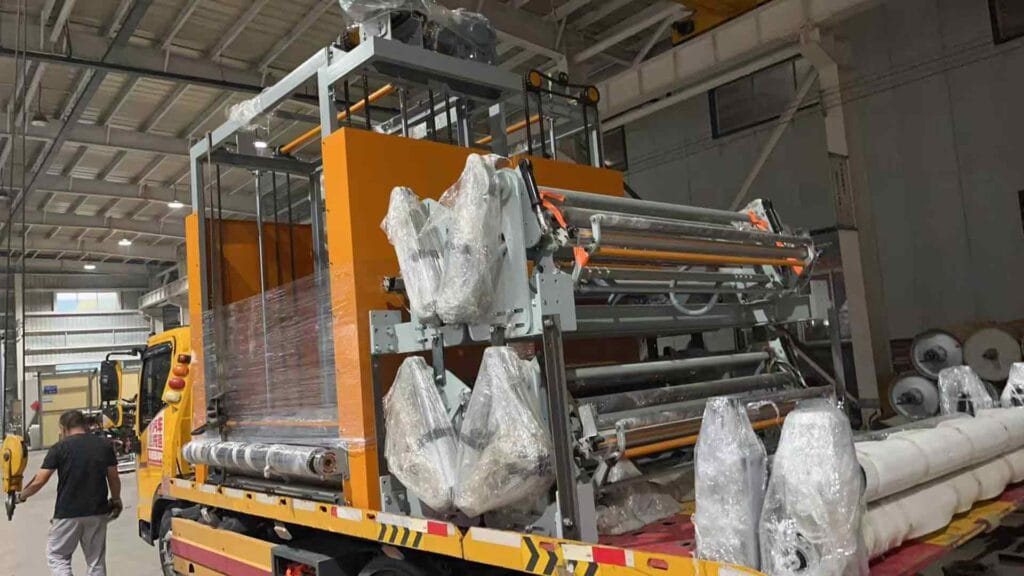
Tension problems can be difficult to identify because the material may look perfectly flat while it remains inside the machine.
The real problem sometimes appears only after tension is released.
Example: Flexible Backing and Stable Surface Layer
Imagine a stretchable textile backing laminated to a relatively stable synthetic leather layer.
If the textile is elongated during bonding, both layers leave the machine together. While machine tension remains present, the laminate can look flat.
Afterward, the textile attempts to recover.
Because the surface layer does not contract by the same amount, the composite may develop curvature or waves.
The lamination itself may be strong, but the material is still unusable.
This illustrates an important principle:
Bond strength and dimensional stability are separate quality characteristics.
Check Tension During Transitions
A laminating machine should remain stable not only during constant-speed running but also during:
- startup;
- acceleration;
- normal production;
- deceleration;
- stopping.
Some web-handling systems perform well at constant speed while becoming unstable during transitions.
Why Pressure Uniformity Is More Important Than Maximum Pressure
Machine specifications often highlight maximum pressure, but industrial users should pay close attention to pressure distribution.
Suppose the center of the material receives more pressure than both edges.
You may see:
- strong center bonding;
- weaker edge bonding;
- different surface appearance;
- uneven thickness.
Increasing total pressure may improve the edges but over-compress the center.
The real solution is pressure uniformity.
Use a Left-Center-Right Test
During trials, collect samples from:
- left edge;
- center;
- right edge.
Compare:
- peel behavior;
- thickness;
- surface appearance;
- dimensional stability;
- edge bonding.
This simple test provides far more useful information than inspecting only a small center sample.
Hot Lamination vs Adhesive Lamination
Different bonding technologies are suitable for different material structures.
| Factor | Heat-Assisted Lamination | Adhesive Lamination |
|---|---|---|
| Bonding principle | Heat-responsive layer/material | Applied bonding medium |
| Key variable | Temperature | Adhesive application |
| Pressure control | Important | Important |
| Drying requirement | Depends on material | Often process-dependent |
| Heat-sensitive substrates | Requires careful control | May provide alternative routes |
| Main quality risk | Thermal deformation | Uneven adhesive or incomplete curing |
| Material compatibility | Must be verified | Adhesive/substrate compatibility required |
This is not a simple comparison of better versus worse.
The appropriate technology depends on the structure you need to produce.
Laminating Machine Use in PU Synthetic Leather Production
Lamination is particularly important in dry PU production because the process builds a multilayer structure through coating, drying, film formation, and bonding.
A modern PU leather dry production line integrates coating, drying, lamination, cooling, and winding into a coordinated manufacturing sequence.
The key word is coordinated.
Optimizing the laminating machine independently while ignoring the surrounding processes can introduce new problems.
Upstream Coating Influences Lamination
If the incoming PU layer has inconsistent thickness or insufficient stabilization, the lamination stage inherits that variation.
The laminating unit cannot fully compensate for an unstable coating process.
Drying Influences Bonding
Material entering lamination should be in the correct process condition.
Insufficient drying or inappropriate thermal history can affect the way layers combine.
Lamination Influences Finishing
After lamination, the material may continue to:
- embossing;
- printing;
- surface treatment;
- inspection;
- cutting.
A seemingly small lamination defect may become much more visible after embossing or other surface processing.
Laminating Machine vs Laminator Machine: Is There a Difference?
Users often search both “laminating machine” and “laminator machine.”
In many industrial contexts, the terms overlap considerably and describe equipment used to combine layers. However, “laminating machine” is often the broader wording used for continuous industrial equipment and production-line systems.
The important distinction is not the name.
It is the process configuration.
When evaluating equipment, focus on:
- supported substrates;
- working width;
- unwinding configuration;
- bonding method;
- tension control;
- heating and drying;
- pressure system;
- cooling;
- rewinding.
Two machines described with the same general name can serve very different applications.
How to Test a Laminating Machine Before Production
A machine trial should reproduce real factory conditions as closely as possible.
Avoid evaluating equipment using only the easiest material combination.
Prepare a Representative Sample Set
Useful test materials include:
- thinnest regular substrate;
- thickest regular substrate;
- most elastic backing;
- softest surface material;
- most heat-sensitive material;
- widest normal roll;
- most difficult combination.
This creates a realistic test range.
Run More Than a Short Sample
A short sample can prove that bonding is possible.
It cannot prove continuous stability.
A longer run allows you to observe:
- tension drift;
- temperature stability;
- edge alignment;
- adhesive consistency;
- winding behavior.
Change the Production Conditions
A particularly useful test is:
Product A → Product B → back to Product A.
Can the operators reproduce the original Product A result?
If not, adjustment repeatability may become a production problem.
How to Evaluate Laminated Material Quality
Visual inspection should be only the first step.
A professional evaluation should consider several dimensions.
Surface Appearance
Check for:
- bubbles;
- wrinkles;
- pressure marks;
- contamination;
- waves.
Edge Bonding
Edges often reveal pressure or adhesive-distribution problems earlier than the center.
Compare the entire width.
Dimensional Stability
Measure the material after it has had time to stabilize.
Check whether:
- width changes;
- curling develops;
- the material contracts;
- the roll becomes wavy.
Bond Consistency
The laminate should not have isolated weak zones.
Testing should sample several positions rather than one convenient point.
Downstream Performance
Take representative material into the next manufacturing stage.
This might include:
lamination → embossing → cutting → sewing.
A laminate that looks smooth at the machine but fails during later processing is not yet a stable production result.
Common Laminating Machine Problems and Their Causes
Troubleshooting is more effective when the first appearance of the defect is identified.
Bubbles Between Layers
Possible causes include:
- trapped air;
- surface contamination;
- uneven bonding layer;
- insufficient pressure;
- incorrect drying;
- poor substrate contact.
Do not immediately increase pressure.
First determine whether the bubble begins before, at, or after the laminating nip.
Wrinkles
Wrinkles often indicate material-handling problems.
Check:
- unwinding;
- web tension;
- alignment;
- roller tracking;
- substrate elasticity.
If a wrinkle exists before the nip, changing lamination pressure is unlikely to solve the root cause.
Edge Lifting
Weak edges may be related to:
- uneven pressure;
- insufficient adhesive coverage;
- edge contamination;
- poor alignment.
Consistent failure on the same side often suggests a systematic machine or application issue.
Curling After Lamination
Curling frequently indicates imbalance between the layers.
Possible factors include:
- different substrate tension;
- different shrinkage behavior;
- thermal exposure;
- asymmetric material construction.
Uneven Bond Strength
If some areas bond well while others do not, inspect the location pattern.
Random defects and defects that consistently follow one position across the width usually require different troubleshooting approaches.
Integrating a Laminating Machine Into the Complete Production Line
A laminating machine should not operate as an isolated island.
The site’s broader leather processing machinery framework includes coating, drying, embossing, laminating, and finishing processes, illustrating why lamination needs to be considered as part of a connected production sequence.
Match Upstream and Downstream Speeds
A laminating unit that operates much faster than surrounding processes does not automatically increase overall output.
The effective capacity is determined by the complete production flow.
Reduce Repeated Handling
Every additional roll transfer introduces opportunities for:
- contamination;
- surface damage;
- tension variation;
- roll misidentification.
A well-planned production sequence can reduce unnecessary handling.
Plan for Future Material Changes
A factory may process more materials over time.
Equipment flexibility can therefore be valuable when it does not compromise current process stability.
Build a Repeatable Lamination Recipe
One of the strongest ways to reduce operator dependence is to document successful settings.
For each regular product, record:
- upper substrate;
- backing substrate;
- thickness;
- width;
- adhesive or bonding system;
- line speed;
- temperature;
- pressure;
- unwinding tension;
- rewinding tension;
- cooling conditions;
- inspection criteria.
Why Process Recipes Matter
Without documented settings, operators may make repeated adjustments from memory.
That approach becomes difficult when many material combinations are involved.
A validated recipe provides a known starting point.
It also makes troubleshooting more systematic because the current settings can be compared with a previously successful production condition.
Maintenance That Protects Lamination Quality
Maintenance should be considered part of quality control.
Clean Rollers Regularly
Adhesive residue, fibers, coating particles, and dust can change roller contact.
Small deposits may create repeated defects across long runs.
Check Roller Alignment
Misalignment can influence:
- pressure;
- material tracking;
- finished thickness;
- edge bonding.
Inspect the Tension System
Check components associated with:
- unwinding;
- web guiding;
- drive control;
- sensors;
- rewinding.
Gradual wear can create gradual process drift.
Verify Temperature Control
Where heating is used, inspect both the control system and actual process response.
A stable displayed value does not automatically guarantee uniform material conditions across the entire working width.
How to Choose the Right Laminating Machine
A useful selection process begins by creating a technical requirement sheet.
Material Requirements
Define:
- material type;
- thickness range;
- working width;
- backing structure;
- elasticity;
- thermal sensitivity.
Lamination Requirements
Define:
- two-layer or multilayer structure;
- bonding method;
- adhesive requirements;
- required finished thickness;
- expected flexibility.
Production Requirements
Define:
- regular operating speed;
- product-change frequency;
- roll dimensions;
- required continuous operation;
- downstream processes.
Quality Requirements
Define acceptable levels for:
- wrinkles;
- bubbles;
- edge alignment;
- dimensional change;
- bond uniformity;
- surface marking.
The clearer these requirements are before equipment configuration, the more meaningful machine evaluation becomes.
Common Mistakes When Selecting a Laminating Machine
Choosing by Maximum Speed
Maximum mechanical speed does not equal usable production speed.
The important question is how quickly acceptable laminated material can be produced continuously.
Ignoring Material Elasticity
Two flexible materials can have very different elongation characteristics.
Tension control should reflect their behavior rather than applying the same treatment automatically.
Testing Only One Easy Material
A strong evaluation focuses on difficult combinations.
The machine should be challenged with the actual production range.
Focusing Only on Bond Strength
A material can have strong bonding and still suffer from:
- curling;
- wrinkles;
- dimensional instability;
- excessive compression.
Quality must be evaluated as a complete structure.
Ignoring Changeover Repeatability
If the factory switches frequently between products, it should be possible to return to established settings without excessive experimentation.
Evaluating Lamination Without Downstream Testing
The laminate should be inspected after the processes it will actually experience.
A problem that appears during embossing may have begun during lamination.
Practical Laminating Machine Selection Checklist
| Question | Why It Matters |
|---|---|
| What materials will be laminated? | Defines process compatibility |
| How different are their elastic properties? | Determines tension requirements |
| What thickness range is involved? | Affects pressure and feeding |
| What working width is required? | Defines machine configuration |
| Which bonding method is used? | Determines process structure |
| Is heating required? | Affects thermal control |
| How will drying or curing occur? | Influences bond stability |
| What production speed is expected? | Affects residence time |
| What happens after lamination? | Defines final quality requirements |
| How often do products change? | Determines setup flexibility |
| Can settings be reproduced? | Determines process repeatability |
These questions provide a more useful foundation than selecting a machine from general specifications alone.
Conclusion
A laminating machine should be evaluated as a process-control system rather than simply a pair of rollers that bonds materials together.
The quality of the final composite depends on how well the equipment manages material behavior, tension, alignment, adhesive distribution, temperature, pressure, speed, cooling, curing, and rewinding.
The most reliable selection method uses actual production materials.
Test the difficult substrates. Inspect the left, center, and right sides. Run the machine long enough to identify process drift. Allow the material to stabilize. Then take the laminate through its downstream manufacturing operations.
For manufacturers planning new material combinations or production-line configurations, defining substrates, working width, thickness, bonding requirements, downstream operations, and quality targets before discussing production requirements makes equipment configuration significantly more precise.
Ultimately, a good laminating machine is not defined by one maximum specification. It is defined by whether it can reproduce a stable composite structure across the full roll, across repeated production batches, and after normal product changeovers.
That repeatability is what turns lamination into a controlled industrial manufacturing process.
FAQ
What is a laminating machine used for in synthetic leather production?
A laminating machine bonds two or more material layers into a stable composite structure. In synthetic leather manufacturing, it may combine PU or PVC surfaces with fabric, foam, nonwoven material, film, or other backing layers while controlling tension, pressure, alignment, and bonding conditions.
What should I check when choosing a laminating machine?
Check substrate type, thickness, working width, elasticity, bonding method, web tension control, pressure uniformity, heating requirements, line speed, cooling, and rewinding. Real material trials are more useful than comparing only maximum machine specifications.
Why does a laminating machine cause wrinkles?
Wrinkles often result from unstable web tension, poor alignment, substrate stretching, uneven feeding, or winding problems. Determine where the wrinkle first appears. If it develops before the laminating nip, increasing pressure at the bonding point is unlikely to solve the underlying cause.
How can I improve bonding consistency on a laminating machine?
Control adhesive distribution, substrate cleanliness, nip pressure, temperature, line speed, web tension, and drying or curing conditions together. Inspect samples across the full material width because strong center bonding does not guarantee equally stable bonding near both edges.
Can one laminating machine process different synthetic leather materials?
A suitable machine can support multiple material structures, but each combination may require different tension, temperature, pressure, speed, and bonding settings. PU, PVC, fabrics, foams, and other substrates should be tested as complete composite structures before production parameters are standardized.